Zero-Waste Cutting Boards: Mycelium vs Wood
By Sanaa Al-Khatib • 12th Apr
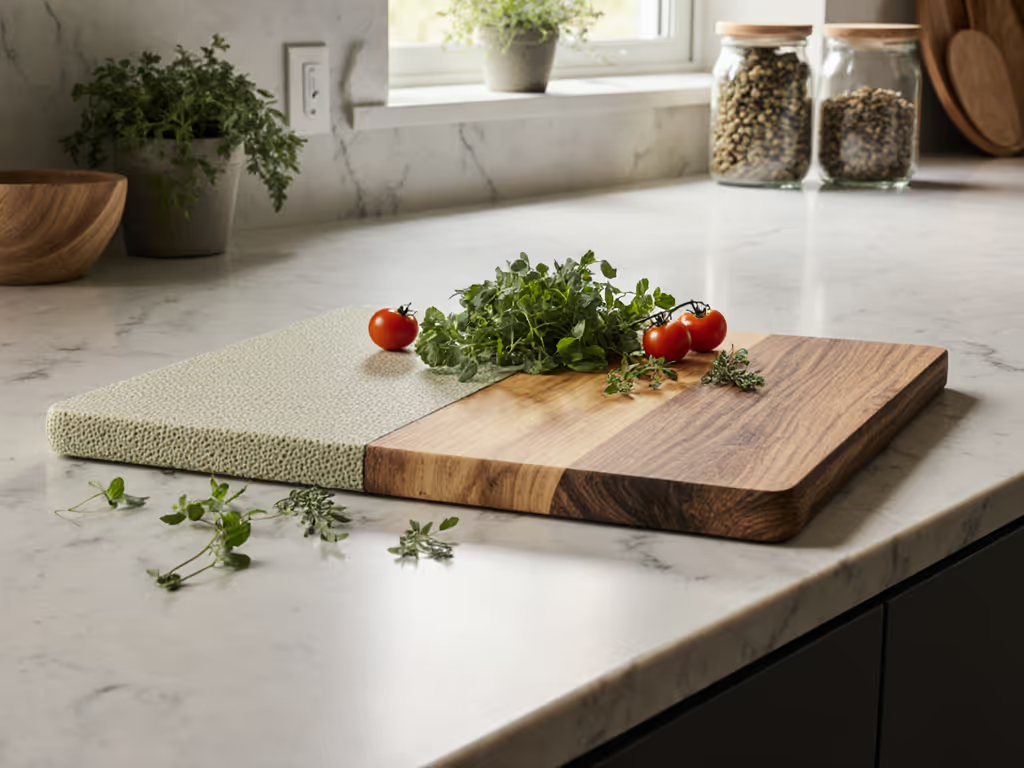
When comparing zero-waste cutting boards made from mycelium vs wood, the decision extends beyond aesthetics into material science, maintenance demand, and long-term kitchen hygiene. Both represent genuine steps away from petroleum-based plastics and disposable consumer patterns, yet they occupy different positions on the spectrum of durability, ease of care, and practical integration into food-prep workflows. This guide evaluates the technical and practical trade-offs to help you choose a zero-waste surface that aligns with your kitchen's demands.
Understanding Zero-Waste Cutting Boards
Zero-waste cutting boards belong to the circular economy kitchen products category, tools designed to minimize resource extraction, manufacturing waste, and end-of-life disposal. The distinction from conventional boards is material and ethos. Traditional plastic and composite boards often involve virgin polymers, adhesives, and layered assembly processes that generate scrap and chemical byproducts. Zero-waste alternatives source reclaimed or rapidly renewable materials, employ simple manufacturing methods, and prioritize single-material or fully biodegradable construction.
According to recent lifecycle assessments, upcycled and certified wood boards can achieve high landfill-diversion rates when sourced from manufacturing waste streams. Emerging mycelium-based boards, meanwhile, are fully compostable and return to soil within months, representing a strong endpoint of circular design. Understanding this distinction frames the comparison: both approaches reject conventional waste, but they operate on different timescales and infrastructure assumptions.
Wood-Based Zero-Waste Boards: Properties and Performance
Wood boards sourced from eco-friendly food prep surfaces occupy the established position in sustainable kitchens. Upcycled and FSC-certified hardwoods (beechwood, walnut, and maple) are the dominant materials.
Material Characteristics
Maple is the preferred choice for serious home and professional kitchens. Hard rock maple offers several measurable advantages: a Janka hardness rating that ranks among the highest for food-contact woods, a fine, uniform grain that resists splitting and edge-chipping, and a surface that accepts knife impact with gentle deflection rather than brittleness. Walnut and beechwood provide intermediate hardness with aesthetic warmth; walnut's dark grain appeals visually, while beechwood delivers consistent color and workability.
These boards are typically constructed from a single slab or unified grain structure, not laminated strips held with adhesives. This construction eliminates a critical hygiene vulnerability: adhesive breakdown and microplastic migration. What remains is pure wood, finished with food-grade oil (commonly linseed) and wax (beeswax or carnauba).
Edge-Friendliness and Maintenance Load
Wood's critical advantage lies in its compliance (the ability to absorb and dampen knife impact). This property directly extends blade edge life by reducing micro-chipping on high-hardness carbon and stainless steels. Unlike glass, stone, or hard composites, wood yields fractionally under the blade, protecting the edge's geometry.
The maintenance load is moderate and predictable. Oiled wood requires periodic reapplication, typically every 2-4 weeks with regular use, to maintain water resistance and surface suppleness. Grain direction matters: wood accepts oil more readily along the grain than across it. Boards finished with linseed oil and beeswax develop a protective patina; surface discoloration and minor stains are expected cosmetic changes that do not compromise function.
Hygiene and Moisture Management
A persistent myth suggests that wood is inherently less hygienic than plastic. Testing contradicts this when maintenance is consistent. For the science behind this, see our bacterial growth research on wood vs plastic. Wood's capillary structure naturally sheds surface moisture when allowed to air-dry; plastic boards, conversely, retain moisture in micro-gouges, an environment favorable to bacterial biofilm formation. The decisive factor is drying protocol: wood must be stood vertically to shed water rapidly from both surfaces, while plastic benefits from heat or bleach if sanitation is a concern.
Wood also resists odor absorption less aggressively than plastic when maintained properly. After food-contact events, particularly raw poultry or fish, a hot water rinse followed by vertical air-drying prevents volatile compounds from lingering. The oiled surface also inhibits staining more effectively than untreated wood or porous plastic.
Mycelium-Based Zero-Waste Boards: Emerging Potential
Mycelium cutting boards represent a newer entrant to sustainable kitchen tooling. For in-depth testing data, see our mycelium cutting boards review. These boards are grown from mushroom mycelium (the root network of fungi) bound with plant-based biopolymers or minimal resin. The material is fully biodegradable and compostable, degrading within weeks to months in standard composting conditions (a property that distinguishes mycelium from even the best upcycled wood alternatives).
Material Characteristics
Mycelium composites are engineered for rigidity and impact resistance comparable to hardwoods in the 1,200-1,600 Janka range. The surface is typically sealed with food-safe, plant-derived finishes. Unlike wood, mycelium boards do not require oil reapplication; the material is inherently stable and does not absorb moisture significantly. This property eliminates a major maintenance task: owners need not manage grain direction, moisture content, or seasonal warping.
Mycelium's structure is non-porous at the functional cutting surface, offering cleanliness characteristics similar to modern composites (such as paper-composite boards used by professional kitchens) without the petrochemical content. Some formulations are dishwasher-safe, though hand-washing is recommended to preserve surface finish and extend lifespan.
Edge-Friendliness and Durability Concerns
The primary limitation of current mycelium boards is insufficient long-term data on edge-friendliness. Wood's compliance emerges from cellular structure and grain orientation, properties that are difficult to replicate exactly in composite mycelium. Early adopters report acceptable performance with European-style chef's knives and Japanese high-hardness steels, though the feedback and give are subtly different from end-grain hardwood (less forgiving, slightly higher impact transmission to the blade). Mycelium boards are not yet recommended for frequent use with expensive, thin-edged Japanese carbons that demand the most elastic cutting surface.
Durability concerns center on surface microstructure. While laboratory testing indicates material stability, mycelium boards have not yet accumulated 5-10 years of kitchen use data. Wood boards, by contrast, are well-documented to last decades and be refinished or resurfaced when needed; mycelium boards, once surface damage occurs, cannot be regenerated or repaired, so they must be composted.
Maintenance and Care
Mycelium boards demand minimal intervention: hand-wash or dishwasher-safe (model-dependent), no oiling required, and drying can occur flat on a rack. This simplicity is attractive to busy kitchens and those resistant to maintenance routines. However, this very simplicity creates a false equivalence to plastic boards. The material is not indestructible; deep gouges or stress fractures can compromise its hygiene and create pathways for bacterial colonization.
Clean habits beat clever gadgets for keeping boards food-safe. This principle applies equally to mycelium and wood. The advantage of mycelium is consistency: its non-porous surface does not require the discipline of vertical drying or regular oiling. For households that struggle with maintenance discipline, this is a genuine benefit.
Sustainability and Circular Design
Both material classes genuinely reduce waste, but on different timescales.
Wood-based boards (when sourced from upcycled or FSC-certified forestry) redirect manufacturing waste that would otherwise enter landfills. They typically last 10-30 years with proper care, and when they reach end-of-life, they can be composted, burned for energy recovery, or sanded and refinished. Some high-quality boards are refinishable (a surface restoration that extends lifespan indefinitely). The sustainability math strongly favors boards used for 20+ years over multiple replacement cycles of shorter-lived alternatives.
Mycelium boards are theoretically superior at end-of-life: they return to soil rather than requiring industrial composting infrastructure. However, this advantage is only realized if the board actually reaches compost, since many consumers discard boards in regular waste where mycelium may decompose anaerobically. Manufacturing mycelium boards also requires grown material (10-14 weeks of cultivation), energy input, and processing, an environmental cost that must be amortized across the board's useful lifespan. A mycelium board used for 3 years and then composted may have a lower overall carbon footprint than a plastic board discarded after 2 years, but it will not outperform a wooden board cared for across 15+ years.
The most sustainable board is the one you actually use consistently and maintain well.
Practical Considerations for Your Kitchen
Moisture and Drying Protocols
Wood boards require active drying management. After use, hand-wash with hot water and mild soap, then stand the board vertically (propped in a dish rack or against a backsplash) to shed water from both surfaces. For step-by-step techniques to prevent warping and extend lifespan, see our wood cutting board maintenance guide. Consistency and airflow keep boards safe more than gadgets do; passive drainage and air circulation prevent moisture accumulation, which is the root cause of swelling, warping, and microbial colonization. Horizontal storage, even on a paper towel, traps moisture and undoes this care.
Mycelium boards, by contrast, shed moisture passively due to their engineered surface tension. They can rest flat immediately after washing. This difference (vertical vs. flat drying) is not trivial for busy households.
Cross-Contamination and Workflow
Both material types can be incorporated into a raw-vs.-ready-to-eat separation system. Some manufacturers offer color-coded sets: red for raw proteins, green for vegetables, yellow for fruit. Compare color-coded cutting board systems to choose a setup that fits your kitchen. The material type does not govern hygiene; the discipline of using separate boards does. Wood boards, if maintained, show visible wear patterns over time (darkening, patina development) that can reinforce visual cues for role differentiation. Mycelium boards remain visually uniform and may require label stickers or intentional color selection during purchase.
Cost and Long-Term Value
Upcycled wood boards typically retail between $60-$200 depending on size, wood species, and maker reputation. Premium end-grain boards from artisan makers reach $300+. Mycelium boards currently occupy a similar price range ($80-$250), though they are less widely available. The value calculation shifts across timelines: if you maintain a wood board across 15 years and refinish it once, your cost-per-year is low. If you replace a mycelium board after 5 years (before composite fatigue or surface damage accumulates), your cost-per-year is higher, but the disposal guilt is eliminated.
Integration with Knife Care
For owners of expensive Japanese knives (600+ honing, 1200+ finish grades), wood boards, particularly end-grain maple, remain the proven choice. The gentle deflection under blade contact directly preserves thin, acute edges. Mycelium boards are suitable for German-style or kitchen shears but are still being tested by the serious edge-care community.
Making Your Decision
Choose wood-based boards if you:
- Own or plan to own high-hardness Japanese steel knives
- Embrace regular maintenance (weekly oiling or periodic wax) as part of kitchen discipline
- Value decades of durability and refinishability
- Prefer established material science and long-term performance data
- Have counter and sink space to practice vertical drying
Choose mycelium-based boards if you:
- Seek minimal maintenance and no oiling requirement
- Prioritize end-of-life compostability and feel confident you will actually compost the board
- Use primarily German or stainless steel knives
- Prefer a non-porous surface that does not require as much drying discipline
- Are willing to accept a 5-10 year lifespan rather than 15-30 years
- Want to experiment with emerging circular-economy kitchenware
Neither choice is wrong; the distinction is whether you optimize for edge protection and longevity (wood) or maintenance simplicity and end-of-life closure (mycelium). Both represent genuine improvements over petroleum-based plastics and disposable alternatives.
Further Considerations
Explore the specific sourcing practices and certifications of individual manufacturers. Look for FSC certification on wood, USDA Biobased status on mycelium, and transparency about manufacturing waste and chemical finishes. Request information on whether boards can be refinished or composted, and clarify the expected replacement cycle. Test a board's feel and weight in person if possible; cutting board performance is as tactile as it is technical. Consider your household's actual behavior: the best board is the one that aligns with your drying habits, storage space, and willingness to maintain. Finally, if you cook multiple times weekly with raw proteins, a two-board system (one dedicated to raw, one to vegetables) offers both hygiene peace of mind and extends the lifespan of each board by reducing cross-exposure to odor and staining compounds.
The path to a truly sustainable kitchen is paved not with perfect purchases, but with intentional choices used consistently and maintained well.
Related Articles